ALSO AVAILABLE IN CT (COMMAND THRUST) MODEL, SEE DESCRIPTION AT THE END OF THE AD, CONTACT US FOR PRICING.
HP / kW - 100 / 74
Engine type - Inline 4 / Single overhead camshaft (SOHC) / 8 valves
Displacement (L) - 2.1
Maximum rpm - 5000-6000
Air induction - High-performance spiral intake manifold
Fuel induction system - Computer-controlled multipoint electronic fuel injection (EFI)
Alternator amps/watts - 35 A / 441 watts with water-cooled voltage regulator
Recommended fuel - Unleaded 98
Recommended oil - Mercury FourStroke 10W-30 oil
Engine protection warning system - SmartCraft Engine Guardian
Compatible with SmartCraft digital technology - Yes
Starting - Electric with smart start
Controls - Mechanical throttle and shift control
Steering - Compatible with large Tiller / Hydraulic power steering / Dual cable mechanical
Shaft length - L: 20" / 508 mm - XL: 25" / 635 mm
Gear ratio - 2.07:1
Dry weight *Lightest model available - 163 kg
CARB star rating - 3
Bore and stroke - 3.5 x 3.2" / 90 x 81 mm
Ignition - SmartCraft ECM 70 digital inductive
Fuel system - Electronic fuel injection (EFI)
Cooling system - Water-cooled with thermostat
Direction - F-N-R
Transom options - Standard
Trim system - Hydraulic lift / Electric trim
Exhaust system - Through propeller
Shallow water trim range (degrees) - 20
Color - Phantom Black
Lubrication system - Wet sump
Max oil capacity - 5.5 qts / 5.2 l
Maximum trim range - 22° (-6° to 16°)
Maximum tilt range - 70° (-6° to 64°)
Quieter than competitors: Mercury 115 FourStroke is quieter than a 115 hp 4-stroke competitor at all speeds.
At idle, Mercury is four decibels below the competition — the competing outboard is 25% louder.
At cruising speed, where conversations usually occur, the competing outboard produces about 15% more noise.
At full throttle, Mercury is over eight decibels quieter — the competing outboard is 50% louder.
Tests conducted by Mercury PDE NVH staff in a semi-anechoic Mercury Marine chamber (Sound Lab).
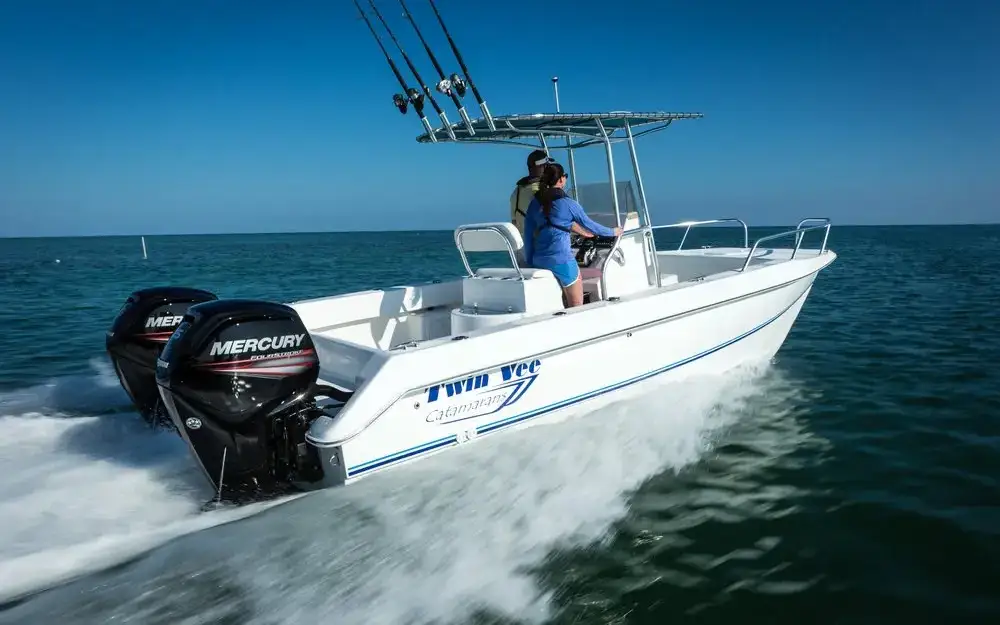
Counter-Rotation: Do you enjoy offshore navigation, even if you don’t plan to acquire a large boat? Mercury offers, for the first time, a 115 hp FourStroke engine with left rotation. Two of these mid-range monsters at the stern provide maneuverability and docking safety similar to twin more powerful hulls, but at a much more affordable price. Unlike competing twin 115 hp engines, Mercury Twin 115 FourStrokes are Command Thrust models with V6 category propellers, like those of the Enertia series, to deliver better acceleration and boat control in choppy waters.
*Available only on 115 hp
Powerful and efficient: Thanks to their lightweight and large displacement, Mercury’s new FourStroke 80 - 115 models deliver generous torque and instant power. Since they don't have to exert as much effort as heavier motors or lower-displacement engines, these engines allow boats to plane faster, accelerate better, and show better fuel efficiency at cruising speeds.
Lightweight and energy-efficient: Mercury’s renowned engineering team has packed incredible power into these lightweight, compact four-cylinder, single overhead cam engines. The 115 hp weighs 9 kg less than its closest four-stroke competitor, making it the lightest low-emission outboard in its power category.
The dry weight refers to the lightest model. Comparative weights are based on base engines without oil, propeller, or integrated steering cylinder. Weights are based on owner’s manual specifications.
A bigger footprint: The Command Thrust transom foot creates a larger water footprint, allowing for better boat control. The larger, fusiform gearcase combined with a larger-diameter propeller can help a heavy boat plane more easily and maintain speed at lower speeds, without affecting top speed.
Quiet operation guaranteed: Equipped with the same maintenance-free valve control as our 150 FourStroke engines, the 80-115 FourStroke outboards are incredibly durable.
Smoother than competitors: Mercury 115 FourStroke emits fewer vibrations and offers a smoother ride than a competitor’s 115 hp 4-stroke.
At idle, vibration levels at the driver’s seat are up to 50% lower than those of a competing outboard.
At the stern, the competing outboard vibrates nearly five times more than Mercury, both at cruising and full throttle.
Tests conducted by Mercury PDE NVH staff at a Mercury Marine test site on a 2013 Bayliner 170.
